

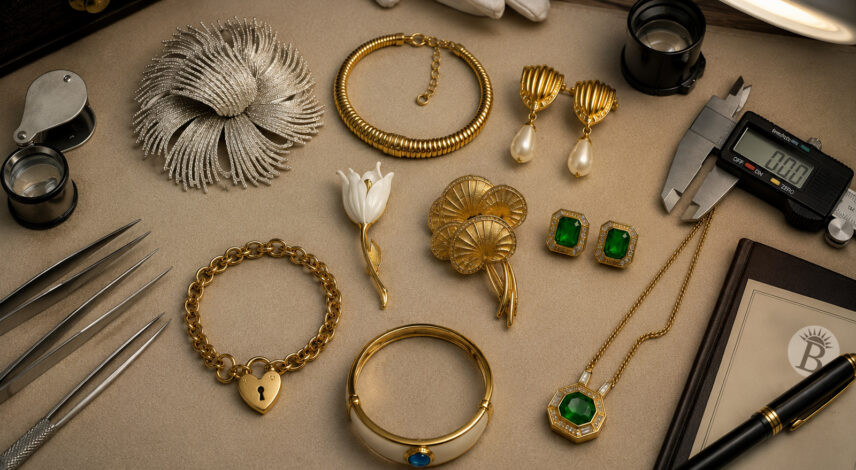

Authenticity Begins with Evidence, Not Assumptions
How to Identify Authentic Vintage Designer Jewellery is one of the most frequently asked questions among collectors, jewellery enthusiasts and vintage jewellery professionals. One of the most common misconceptions in the world of vintage designer jewellery is the belief that authenticity can be confirmed simply by finding a signature, hallmark or maker’s mark. In reality, authenticating a vintage piece is a far more sophisticated process.
Over the years, many genuine pieces have been repaired, restored or modified, while countless reproductions have been created with convincing signatures and markings. A signature alone cannot prove authenticity, just as the absence of one does not automatically mean a piece is not genuine.
Authenticating vintage jewellery is much closer to historical investigation than simple visual inspection. Every characteristic of a piece should be evaluated alongside the others to determine whether they collectively support the same historical explanation.
Rather than relying on one decisive feature, experienced collectors examine multiple independent forms of evidence that either reinforce or contradict one another.
Understanding Authenticity
Learning how to identify authentic vintage designer jewellery begins with understanding the difference between authenticity, age, condition and attribution.
Before attempting to authenticate any vintage jewellery, it is important to distinguish between several terms that are often confused.
An authentic piece is one genuinely produced or authorised by the jewellery house, designer or manufacturer to which it is attributed. Authenticity refers to origin rather than condition. A bracelet that has been professionally restored may still be entirely authentic, while a flawless modern reproduction remains a reproduction regardless of how convincing it appears.
Likewise, the term vintage generally refers to jewellery that is at least twenty years old. However, age alone does not determine quality, rarity or authenticity. Many vintage pieces are relatively common, while others have become highly sought-after due to their historical importance, craftsmanship or rarity.
Designer jewellery should also be distinguished from signed jewellery. A signature identifies a commercial name or manufacturer, but it should never be treated as definitive proof of authenticity without supporting evidence.
Why a Signature Is Never Enough
Anyone trying to identify authentic vintage designer jewellery should look beyond signatures and hallmarks, examining every observable feature before reaching a conclusion.
Many buyers begin by searching for a logo, hallmark or designer’s signature. Although these markings are valuable, they should always be interpreted within the wider context of the piece.
Modern reproductions may imitate signatures with remarkable accuracy. Conversely, authentic jewellery may have lost identifying marks through decades of wear, restoration or replacement components.
Instead of asking whether a piece has a signature, a more useful question is:
Does every observable feature support the same conclusion?
Construction, materials, manufacturing quality, historical period, wear patterns and documented provenance should all work together. When one characteristic clearly contradicts the others, further investigation is required before reaching any conclusion.
Responsible authentication depends on consistency rather than isolated evidence.
The Baharash Authentication Framework
The Baharash Authentication Framework is built around one simple principle:
Evidence should corroborate evidence.
Rather than allowing one feature to dominate the assessment, the framework evaluates jewellery through five interconnected areas:
- Identity – signatures, maker’s marks, trademarks and hallmarks.
- Manufacture & Construction – engineering, clasps, hinges, soldering and assembly.
- Materials – metals, plating, gemstones, crystals, enamel and other components.
- Chronology – whether the design, construction and materials genuinely belong to the same historical period.
- Provenance – documentation, receipts, catalogues, archives and ownership history.
Each category contributes valuable information, but none should outweigh clear contradictions found elsewhere. Confidence grows only when independent evidence consistently points towards the same attribution.
Looking Beyond the Surface
Once the identity of a piece has been considered, attention should turn to the way it was actually made. In many cases, the construction of vintage jewellery reveals far more than its decorative appearance. While a design may be copied with surprising accuracy, faithfully reproducing the manufacturing methods, engineering and finishing techniques of an original piece is considerably more difficult.
For this reason, experienced collectors often spend as much time examining the reverse of a jewel as they do admiring its front. Clasps, hinges, pin mechanisms, soldering and stone settings frequently preserve evidence that is difficult to imitate convincingly.
A well-made vintage piece normally displays consistency throughout its construction. Components should appear proportionate, carefully assembled and appropriate for the period in which the jewellery was produced. Differences do not automatically indicate a forgery, however. Many authentic pieces have been repaired during their lifetime, and sympathetic restoration should be recognised as part of an object’s history rather than confused with evidence of reproduction.
Materials provide another important layer of evidence. Metals, plating, gemstones, crystals, enamel and synthetic materials should all be historically plausible for both the manufacturer and the period in question. The objective is not simply to identify what a piece is made from, but to determine whether every material works together to support the proposed attribution.
Natural ageing also deserves careful interpretation. Genuine vintage jewellery usually develops wear gradually through years of handling and use. Raised edges, clasps and moving parts often show signs of wear before protected areas. Even so, ageing alone should never be treated as proof of authenticity, as storage conditions, cleaning, restoration and frequency of use can all influence appearance.
Historical consistency is equally important. Every authentic piece belongs to a particular period, and its design, materials, manufacturing techniques and identifying marks should all point towards the same historical timeframe. Jewellery should never be dated solely by style, as fashions frequently return and many classic designs have been reproduced over several decades. Instead, chronology should emerge naturally from the combined evidence rather than from one visual impression.
Documentation can strengthen an attribution, but it should always support the physical evidence rather than replace it. Original receipts, catalogues, archive photographs, auction records and presentation boxes may provide valuable historical context, yet none of these items can independently prove authenticity. Likewise, stories about previous ownership may be genuine, but they remain anecdotes unless supported by verifiable documentation.
One of the most important principles of the Baharash Authentication Framework is recognising that authenticity and originality are not always the same. A vintage brooch fitted with a replacement clasp, a necklace restrung with care or a bracelet containing one replacement stone may still be entirely authentic. Such interventions affect condition and originality, but they do not necessarily alter the true origin of the piece. The aim is to understand what has changed over time while identifying what remains original.
Perhaps the greatest mistake collectors make is searching for evidence that confirms their first impression while overlooking evidence that contradicts it. Responsible authentication requires the opposite approach. Every observation should be tested objectively, and contradictions should be investigated rather than ignored. Confidence should grow gradually as independent forms of evidence begin to reinforce one another, creating a consistent historical explanation for the object being examined.
Final Thoughts
Authenticating vintage designer jewellery is not about finding one perfect signature, one matching photograph or one convincing story. It is a disciplined process of evaluating whether multiple independent forms of evidence support the same historical conclusion.
Throughout this guide, we have seen that identity, construction, materials, chronology and provenance should never be considered in isolation. Each provides valuable information, but true confidence is achieved only when these elements consistently reinforce one another. When contradictions appear, they should be investigated rather than ignored.
Equally important is recognising that authenticity is not the same as untouched condition. Many genuine vintage pieces have been carefully repaired or sympathetically restored during their lifetime. Such interventions may influence originality, but they do not necessarily alter the object’s authentic origin. Understanding the difference between restoration, alteration and reproduction is essential for responsible collecting.
Collectors should also remain cautious of common authentication mistakes. A signature should never outweigh conflicting physical evidence, while the absence of a signature should not automatically exclude authenticity. Online image comparisons, seller descriptions and presentation boxes may all contribute useful context, but none should replace a careful examination of the jewellery itself.
The Baharash Authentication Framework encourages an evidence-led approach that values careful observation over quick assumptions. Rather than asking whether one feature appears convincing, it asks whether every observable characteristic supports the same historical explanation. This structured methodology helps collectors make more informed decisions while communicating conclusions with greater accuracy and transparency.
Whether you are building a private collection, purchasing an important vintage piece or simply wishing to understand jewellery more deeply, the most reliable approach is always to let the evidence guide your judgement. Authenticity is earned through consistency, not coincidence.

About the Author
Written and Authored by Bahar Ashrafi
Founder of Baharash Jewels, Bahar Ashrafi is an award-winning jewellery designer recognised by the Goldsmiths’ Craft & Design Council (UK). Based in London, her work combines vintage jewellery, symbolic design and historical research, with a particular focus on craftsmanship, identity and timeless elegance.
Through the Baharash Ltd, she promotes an evidence-led approach to jewellery authentication, encouraging collectors, professionals and enthusiasts to evaluate vintage jewellery through careful observation, historical context and multiple independent sources of evidence, rather than relying on a single characteristic. This methodology reflects the same principles of precision, transparency and respect for craftsmanship that define her work as a jewellery designer.
© 2026 Bahar Ashrafi. All Rights Reserved.
Written and Authored by Bahar Ashrafi.
Founder of Baharash Ltd.
Award-Winning Jewellery Designer.
London, United Kingdom
Learn more about Baharash and our approach to vintage designer jewellery.