

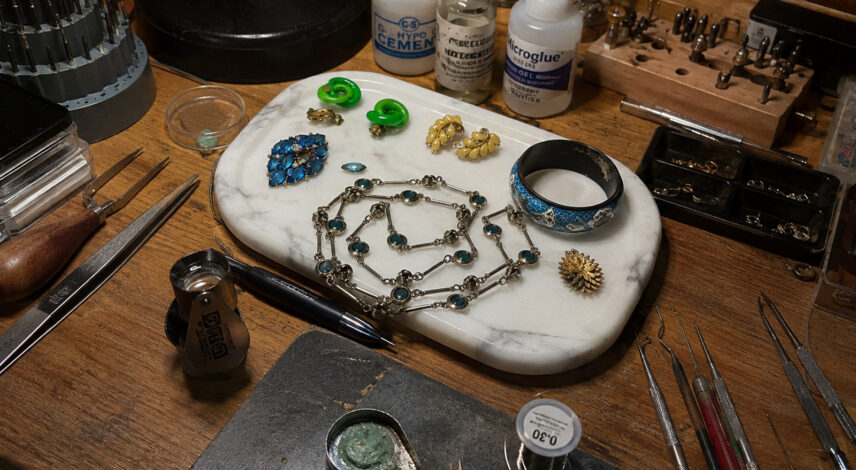

How to Examine Vintage Jewellery Construction
Introduction
The beauty of vintage jewellery often captures attention first, but appearance alone rarely tells the full story. Experienced collectors and jewellery specialists know that the hidden construction of a piece can provide some of the strongest evidence of its authenticity.
Features such as hinges, pin mechanisms, clasps, solder joints and stone settings often reveal how a piece was made, the manufacturing standards of its period and, in some cases, the working methods of a particular maker. Unlike decorative details, these structural elements are far more difficult to copy convincingly.
However, construction should never be viewed in isolation. Reliable authentication combines construction with other evidence, including materials, manufacturing techniques, hallmarks, maker’s marks, historical chronology and provenance. When these factors support one another, they provide a far more dependable assessment than any single feature alone.
Why Construction Is One of the Strongest Forms of Authentication Evidence
Construction reflects how jewellery was engineered to function. Hinges must move correctly, clasps must fasten securely and solder joints must withstand years of wear. Because these features are practical rather than decorative, they often remain consistent within particular workshops, manufacturers and historical periods.
Many jewellers developed recognisable methods for assembling components, positioning hinges and finishing the reverse of a piece. While styles changed over time, construction techniques often remained remarkably consistent, making them valuable evidence during authentication.
Rather than relying on a single detail, collectors should assess the overall consistency of the piece. A well-made brooch, for example, should show harmony between its hinge, pin, catch and soldering. Construction is therefore one of the strongest forms of authentication evidence, especially when supported by other independent factors.
Why the Reverse of a Piece Is Often More Informative Than the Front
The decorative front naturally attracts attention, but experienced specialists often spend just as much time examining the reverse.
The back of a piece frequently reveals manufacturing details that are less affected by polishing or restoration, including:
- Hinges and pin mechanisms
- Solder joints
- Component assembly
- Casting quality
- Finishing techniques
- Structural reinforcement
- Areas of repair or replacement
These functional details often provide a clearer understanding of how the jewellery was originally made. They may also reveal professional repairs, later alterations or replacement components that are not visible from the front.
For this reason, authentication should never rely solely on appearance. The reverse deserves equal attention and often provides the most valuable construction evidence.
Caption: Annotated diagram identifying key construction features including hinge, pin mechanism, solder joints, stone settings and clasp.
Alt text: Diagram showing the principal construction components of vintage jewellery.

Examining Hinges
A hinge may seem like a simple component, but it is often one of the most informative features in vintage jewellery. A well-made hinge should operate smoothly, support the pin correctly and fit naturally within the overall construction.
When examining a hinge, consider:
- Overall hinge style
- Precision of assembly
- Alignment
- Smoothness of movement
- Method of attachment
Well-manufactured hinges usually move evenly without excessive looseness or stiffness. Their design should also be appropriate for the jewellery’s likely period of manufacture.
Wear or professional repair should not automatically raise concerns. Many authentic vintage pieces have been repaired during decades of use. The important question is whether the hinge remains mechanically sound and historically consistent with the rest of the jewellery.
Evaluating Pin Mechanisms
The pin mechanism is one of the most important structural features of a vintage brooch, offering valuable insight into both craftsmanship and historical consistency.
Rather than examining the pin in isolation, assess how it works with the hinge and catch. All components should function as a unified system that reflects the jewellery’s original construction rather than later alterations.
When examining a pin mechanism, consider:
- Pin thickness
- Straightness
- Alignment
- Method of attachment
- Spring tension (where applicable)
- Relationship between the pin and the catch
An authentic vintage brooch should display balanced engineering, with a pin that is appropriate for the jewellery’s size and weight. Light wear, gentle polishing and minor movement are normal signs of age, provided the mechanism remains functional and mechanically consistent.
Collectors should also check whether the pin style matches the likely production period. Modern replacement pins are common in restored jewellery and do not necessarily affect authenticity. The key is recognising them as later repairs rather than original construction.
Examining Catches and Clasps
Clasps secure jewellery during wear and often provide useful evidence of manufacturing quality.
Whether examining a brooch, bracelet or necklace, pay attention to:
- Overall manufacturing quality
- Reliability of operation
- Integration into the design
- Evidence of repair or replacement
A well-made clasp should be proportionate to the jewellery and securely attached. It should appear as part of the original engineering rather than an improvised addition.
Replacement clasps are among the most common repairs found on vintage jewellery. Their presence should not automatically suggest forgery. Instead, determine whether the repair has been professionally carried out and remains consistent with the original construction.
Because many authentic pieces have been worn for generations, sympathetic restoration is often expected. The objective is to assess whether the clasp remains historically and mechanically appropriate.
What Soldering Quality Can Reveal
Soldering permanently joins the components of a piece and can reveal important information about manufacturing quality and later restoration.
When examining solder joints, look for:
- Clean, neat joints
- Consistent solder application
- Precise assembly
- Strong structural integrity
Professional workmanship generally produces tidy solder joints that blend naturally into the design. Excess solder, uneven joins or poorly finished repairs may indicate later intervention, although they should always be interpreted carefully.
Many authentic vintage pieces have undergone professional restoration. A repaired solder joint does not reduce authenticity on its own but forms part of the jewellery’s history. The aim is to distinguish original construction from later maintenance while evaluating the overall quality of the work.
Stone Settings as Evidence of Manufacturing Quality
Stone settings combine engineering with craftsmanship and provide valuable evidence of manufacturing standards.
When examining mounted stones, consider:
- Uniformity of settings
- Alignment
- Security
- Consistency between identical settings
- Overall quality of finish
Whether the jewellery uses prongs, bezels or channel settings, each should be secure, proportionate and consistent with the overall design. Repeated settings should demonstrate a similar standard of workmanship throughout the piece.
Collectors should distinguish between original construction and wear caused by decades of use. Loose stones, worn prongs or minor distortion often result from age or restoration rather than poor manufacture.
However, if multiple settings display inconsistent workmanship or structural weakness, further examination may be justified. Always assess the overall pattern rather than focusing on a single imperfection.
Why Engineering Consistency Matters
One of the defining characteristics of quality vintage jewellery is internal engineering consistency.
While hand-finished pieces may show slight variations, all structural elements should work together logically.
Engineering consistency means that the hinge, pin, clasp, soldering and stone settings appear to belong to the same manufacturing process.
Useful questions include:
- Do the hinge, catch and pin appear to have been designed together?
- Is the engineering appropriate for the jewellery’s size and weight?
- Do the decorative and structural elements complement one another?
- Are repeated components finished to a similar standard?
Jewellery assembled from unrelated parts often reveals inconsistencies in workmanship or construction. For this reason, collectors should evaluate the relationship between all structural features rather than relying on a single detail.
A careful understanding of vintage jewellery construction is essential for recognising authentic craftsmanship and making confident collecting decisions.
Distinguishing Repairs from Poor Original Construction
One of the greatest challenges in authentication is distinguishing professional restoration from poor original workmanship.
Many authentic vintage pieces have undergone repairs, including:
- Replacement clasps
- Reinforced hinges
- Resoldered joints
- Reset gemstones
- Replacement pin stems
These repairs are entirely consistent with jewellery that has been worn and cared for over many years.
Rather than asking whether repairs exist, collectors should consider whether they respect the original engineering of the piece. Professional restoration usually preserves the jewellery’s character, while poor repairs may introduce uneven soldering, awkward proportions or structural inconsistencies.
Understanding this distinction is an essential part of evidence-based authentication. A restored piece can remain fully authentic, provided its overall construction remains historically and mechanically consistent.
Common Construction Mistakes Collectors Overlook
When examining vintage jewellery, collectors sometimes focus too heavily on appearance while overlooking important structural evidence. Even experienced buyers may reach incorrect conclusions by relying on a single feature instead of evaluating the piece as a whole.
Common mistakes include:
- Examining only the decorative front
- Ignoring solder joints and assembly methods
- Assuming replacement components always indicate forgery
- Overlooking inconsistencies between the clasp and the overall construction
- Confusing normal wear with manufacturing defects
- Treating one feature as conclusive evidence
Reliable authentication requires every structural element to be assessed together rather than individually.
Caption: Illustration highlighting common wear patterns and construction features on vintage jewellery.
Alt text: Diagram showing typical construction details and natural wear on vintage jewellery.

Construction Should Be Evaluated Alongside Other Evidence
Construction provides valuable authentication evidence, but it should never be considered on its own.
Even a well-made piece should be assessed alongside:
- Signatures and maker’s marks
- Hallmarks
- Materials and finishes
- Manufacturing chronology
- Design characteristics
- Provenance
The strongest conclusions are reached when all forms of evidence support one another.
Conclusion
Understanding vintage jewellery construction is one of the most reliable ways to authenticate antique pieces because it reveals how they were engineered rather than simply how they look.
By examining hinges, pin mechanisms, clasps, solder joints, stone settings and overall engineering, collectors gain valuable insight into manufacturing quality and historical consistency. However, construction alone cannot confirm authenticity. Repairs, restoration and decades of use may alter individual components without changing the identity of a piece.
The most dependable assessment combines construction with materials, hallmarks, maker’s marks, chronology and provenance to form a balanced, evidence-based conclusion.
FAQ
Why is the back of vintage jewellery important?
Vintage jewellery construction provides valuable evidence about craftsmanship, manufacturing techniques and authenticity that cannot always be seen from the front of a piece.
Do repaired pieces automatically lose their authenticity?
No. Professional repairs are common, but vintage jewellery construction should always be evaluated alongside materials, hallmarks and provenance.
Can construction alone prove authenticity?
No. Construction is highly valuable but should always be assessed alongside materials, hallmarks, maker’s marks, chronology and provenance.
Which construction features should be examined first?
Start with the reverse of the jewellery, paying close attention to hinges, pin mechanisms, catches, solder joints and stone settings before evaluating how these elements work together.
About the Author
Written and Authored by Bahar Ashrafi
Founder of Baharash Jewels, Bahar Ashrafi is an award-winning jewellery designer recognised by the Goldsmiths’ Craft & Design Council (UK). Based in London, her work combines vintage jewellery, symbolic design and historical research, with a particular focus on craftsmanship, identity and timeless elegance.
Through the Baharash Ltd, she promotes an evidence-led approach to jewellery authentication, encouraging collectors, professionals and enthusiasts to evaluate vintage jewellery through careful observation, historical context and multiple independent sources of evidence, rather than relying on a single characteristic. This methodology reflects the same principles of precision, transparency and respect for craftsmanship that define her work as a jewellery designer.
© 2026 Bahar Ashrafi. All Rights Reserved.
Written and Authored by Bahar Ashrafi.
Founder of Baharash Ltd.
Award-Winning Jewellery Designer.
London, United Kingdom
Discover the world of Baharash through our collection of authentic Vintage Brooches, where timeless craftsmanship and remarkable history come together.